Many people believe that if you are intellectually gifted, everything comes easily to you. If you have any problems whatsoever, you can overcome them easily.
This is in fact incorrect. Gifted adults have to deal with their own, special kinds of issues, many of which are not easily understood by the majority of the population. Very often, gifted adults find life even more troubling than people who are not as fortunate simply because they understand more about the world and therefore are aware of more of the human condition.
We will start by focusing on one aspect of giftedness: intellectual giftedness. There are in fact multiple ways in which someone may be seen as gifted: athletic (Michael Jordan was certainly a gifted athlete), spiritual (some people may be able to sense the divine more than others), beauty (a supermodel can be gifted in this area) and others. Many of these attributes are independent of each other and very likely undervalued by society. This may be addressed in a future post.
The first issue a gifted adult has to deal with is the fact that many people assume that if you are gifted in one intellectual discipline, you are gifted in all of them. This is not true, especially if you have extensive training in one area and have a reputation a such.
In my case, consider the following. I know a lot about math and science and can answer many questions in those fields. Now suppose someone came to me and asked me a question about botany. I know nothing about botany, something which may surprise the person asking the question. Inevitably, he or she may ask, “How can someone so smart be so stupid?”
Jagged profiles are not uncommon among gifted adults. One of my theories is that all humans have roughly the same number of brain cells, and if you decide to specialize in one area you devote most of those cells to that discipline. This, by necessity, leaves fewer left over to absorb information from all the others. An autistic savant may be an extreme version of this in which the person has amazing talent in one ability but earns it at a devastating cost. As my saying goes, “[Kanner] autism is when you can solve world hunger and not tell anyone.”
Now it is certainly possible that if I turned back time to the point in my childhood where I had to choose between botany and computer science, I could have focused on becoming a botanist instead of a software engineer. In that case, I could have become a gifted botanist but never attained proficiency in software engineering. The point is, a gifted person may start out with the potential to be gifted multiple fields but as time goes by the number of possibilities shrinks.
Another issue gifted adults have to deal with is something I call the Cassandra effect. In this scenario, the gifted adult tries to describe what he or she is saying to the masses but is unable to get the point across due to cognitive differences between the speaker and the audience.
There are reports which claim that efficient communication is only possible when there is a gap of at most 20 IQ points between the two individuals. This poses a problem to a visionary pioneer who has an IQ of 150. Suppose he has a great philosophical or intellectual discovery which he wants to announce to the world. In order to transmit this information, he needs to convey the concept in its entirety to people who will be able to understand it.
In order to do so, however, the recipient will have to have an IQ of 130 or higher. Those individuals are exceptionally rare on their own, about 2% of the population. We’re talking MENSA level here. In theory, those individuals can then educate people to whom the general populace (IQ 90-110) can relate.
Things never go as planned, however. Suppose the pioneer relays the information through the MENSA-level intermediary to someone with an IQ of 110. There will likely be some misunderstanding somewhere along the way, not uncommon in oral traditions (think of playing Telephone as a child). The more intermediaries one uses, the more likely the message will be garbled. To make matters worse, once the message has been transmitted to the masses in the IQ 100 format, it will likely be left in the caretakers of community leaders whose IQ is 110-120. This will almost certainly cause the community to be served with an interpretation of the visionary’s idea which may not be as comprehensive as the visionary originally intended.
Now suppose the pioneer tries to approach the community directly, without using intermediaries. He will believe he has gotten the message across. However, the message the community has received may not be the message the speaker intended. The community will then do the wrong thing with the information, which can be especially difficult to undo once the pioneer has passed on.
Very often, the pioneer is likely shunned by society if he approaches the community directly. Think of spiritual leaders like Jesus and Mohammed. The prophet Jeremiah was supposedly thrown into a pit when he tried to convince the king to amend his ways. Albert Einstein was seen as socially awkward and intellectually deficient until people understood his genius.
I initially found it surprising that the mathematical community had found it very difficult to recruit people to evaluate Andrew Wiles’s proof of Fermat’s Last Theorem. In retrospect, given how brilliant Wiles is, the 20 IQ point communication limit seems to be coming into play here.
A third aspect of gifted trauma involves profound loneliness, potentially related to the misunderstanding mentioned in the previous section. The person with 150 IQ would only be able to find a true peer out of a community which comprises 2% of the population. Once he or she gets out of an academic environment, these people may be very difficult to discover (unless one gets online). Dating may be extremely difficult under these circumstances, and the gifted individual may have to be content with several superficial relationships if he cannot find a true equal.
Gifted people often have to deal with forced adoption of societal norms which are designed for, and enforced by, people who are not as fortunate. They may find it unfair to have to limit their abilities and exposure to interact in the world, especially if they truly want to use their knowledge to help. Frustration and boredom is commonplace.
Finally, there is the belief that there are phase transitions in cognitive functioning at IQ’s roughly of 140 and 170. An analogy I use is seeing the world in three dimensions at IQ 120, four dimensions at 140, four dimensions with glasses at 160, and five dimensions at 180. You can communicate as well as you want, but if you are assuming the person sees the same number of dimensions as you do it won’t work well. How can one describe a sphere to someone who lives in a two-dimensional world? Similarly, how can a three-dimensional being imagine a world in only two dimensions if he has cannot conceive the world as being that way?
Gifted people often like to learn and understand things more deeply and feel things more strongly than people who are not as fortunate. This often amplifies their reactions and sensations (consider Dabrowski’s overexcitabilities). If the human condition is hard to deal with for most individuals, imagine how it would be for someone who is more attuned to it. You can now imagine great religious leaders asking for “their cup to be taken from them”.
The simple truth is this: a gifted individual with IQ 150 has as much of a challenge interacting with the world as an intellectual challenged individual with IQ 50 does. There are programs in place to try to assist those with IQ 50. However, there are very few in place for people with IQ 150, even though there are roughly the same number of people in those categories. The people with IQ 150 are left to fend for themselves with very few people trained to advise them and even fewer realizing that they need assistance to begin with. There needs to be more support in this area.
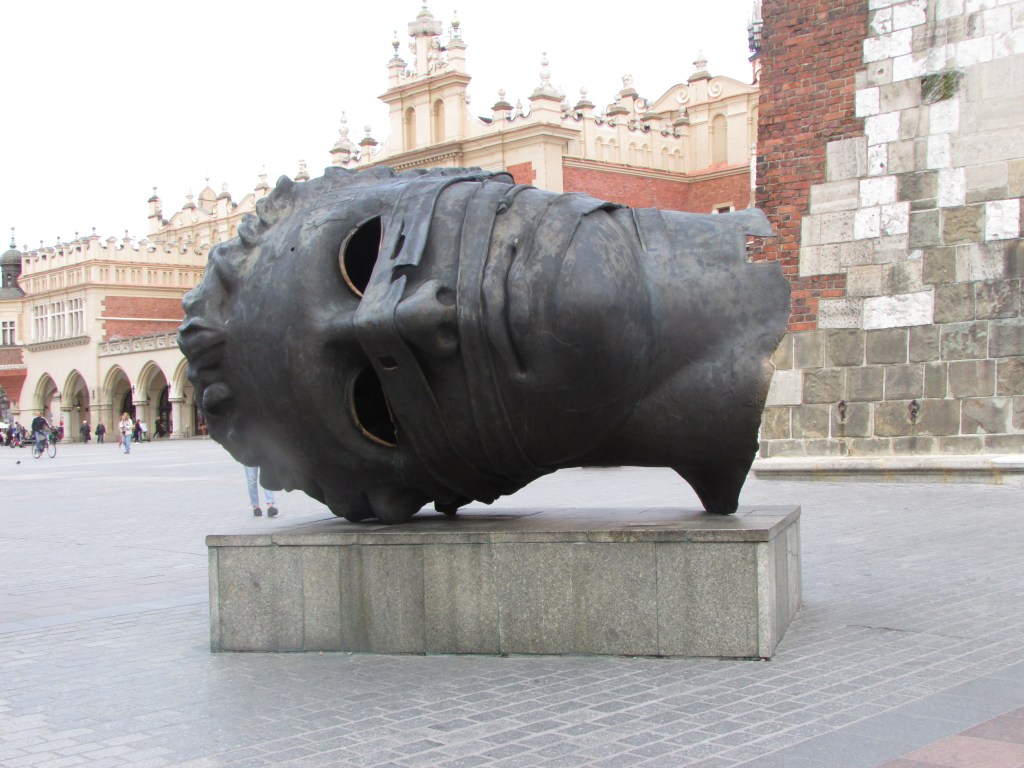
The photo is from the main square in Krakow, Poland. If you’re focusing on your head too much things will get into trouble as you are not a complete individual.
 Brookline Polymath