If you are like many people, you may think that you are very well informed about the world and can see things objectively. You are well adjusted to your environment and seem to be comfortable with everything around you. However, that may not in fact be the case. There may be an entire world out there that you just happened to be unaware of or have had no exposure to it. If you are aware of it, the lack of exposure may cause you to believe things about it which are likely skewed or incorrect without you realizing it.
The story of the Buddha comes to mind. The Buddha began life as a prince, spending all of his time in the palace and living a luxurious lifestyle for his time. He grew up accustomed to a high standard of living, and his father made sure that he never had to worry about all of the issues that commoners had to deal with. Although he may have intellectually known that most people were not like him, he didn’t have any personal experience in that area.
One day, however, his curiosity got the best of him and he ventured outside the palace against the will of his father. For the first time, he was exposed to the true realities of the human condition in the form of old age, sickness, and death. This shocked him a great deal and caused him to start to reconsider his life. He eventually decided to leave the palace and embark upon a spiritual journey.
Had the Buddha not ventured outside the palace, he would have never known about humanity in its truest form until much later, if at all. He would have lived his life in a self-contained universe without having even realized it.
In short, he would have lived in a bubble. A bubble of life and air in a great ocean of despair. A green and vibrant Earth in the vast depths of space.
I had to contend with bubbles myself. I grew up in a white, upper-middle class, intellectual Jewish household where almost all of my family’s friends were educated Jews (and practicing Jews at that). I knew that non-Jews existed, but I simply had no exposure to them other than our family’s cleaning lady. School did not help as I was sent to Jewish private school. In fact, I sometimes believed that if you did not go to synagogue you were not Jewish!
After high school I went to MIT for college. Although I started interacting with non-Jews for the first time (and enjoyed talking to them), I has still not broken the bubble of intellectuality as MIT is a very elite school. Furthermore, my parents were heavily involved in MIT Hillel (having met at MIT Hillel in the 60’s) and strongly pressured me to get involved with that organization. I eventually caved, not realizing that they were pressuring me to get back into the bubble I was raised with.
Brandeis was next for graduate school. Although this school provided me another opportunity to meet people from other countries in the computer science department, I found myself spending most of my time with the undergraduates as several of my high school classmates were still there. So all of my friends were Jewish and for the most part upper middle class.
After graduate school came a stint in the young adult community which was focused on JAGSS, a Jewish singles group based out of Harvard Graduate School. Needless to say, those people were more like me, highly educated and Jewish. So the bubble was still there for the most part, even though I had expanded my social sphere greatly from my perspective. And I was already in my late 20’s and early 30’s. Throughout all this time I was still more or less practicing and observing religion the way I had been raised.
This is when things suddenly changed. A chance encounter at the Smithsonian Center for Astrophysics around 2005 introduced me to a friend who eventually became my first girlfriend. She was smart, as she was working on her PhD at Harvard. However, her background was completely different. She grew up in a working to middle class WASP family in an area of Massachusetts which I had known nothing about (all I knew was we had to drive through it to get to the beaches on Cape Cod). Her family spanned the entire political spectrum from extreme left to extreme right, and she was the first person in her family to get an advanced degree. Her parents had divorced (unexpected from my vantage point despite the high divorce rate) and found new partners, providing her with several stepsiblings.
I felt awkward at first with her family but found they the family very closely knit despite their political differences. For the first time, I had truly felt I was part of an actual clan as compared to an abstract ethnic group. Yes, their house was smaller. But they seemed very nice people. One thing I noticed, however, is that one right-wing member had looked at the town I had been raised in with contempt, calling it “Snooton” instead of Newton. Looking at Newton from the perspective of someone outside my bubble, I understood his claim very well and agreed with his view.
The Buddha had discovered the middle class and Gentiles.
I still remember the time when a couple of Jewish friends and I started talking a friend of her family, asking him where he had gone to college. He said, “I never went to college”. I remember our jaws collectively dropped? How is it possible someone didn’t go to college. The man was clearly a smart guy, and I had apparently fallen for the stereotype that people who weren’t educated couldn’t be smart. I should have realized that my own grandfather in Curacao had been a very bright man but had barely a grade school education.
The Buddha had broken out of the intellectual bubble.
Fast forward a few years and I meet a young woman living in Boston. She’s also extremely bright, supposedly with a 150 IQ. However, I was completely unprepared when she told me that I was openly rich and didn’t realize it. I figured I was like everyone else living in Brookline. What I hadn’t realized was not only the Boston area relatively affluent but areas outside Massachusetts were often much worse off. What’s more, I would likely not have recovered from my social awkwardness without therapy which would have been out of reach in less affluent neighborhoods. She made me realize that if I could afford Brookline, I was rich.
This woman had grown up in rural Appalachia under circumstances which I literally could not even conceive of. For those of you familiar with ACEs (Adverse Childhood Experiences), she had faced at least 9 of the 10. I had had none. Very often her family had not been sure they would be able to put food on the table or a roof over their heads. Needless to say, questioning the security of lower levels of Maslow’s hierarchy when you’re operating at higher levels was something which hadn’t even occurred to me.
Later friends have included a First Nations indigenous Canadian (whose tribe is very welcoming and was offended that I had been worried I would have offended him on a visit), a New Age energy healer, a Haitian immigrant nurse who sees shows on TV and laments that her family would never be able to enjoy those luxuries, an El Salvadoran from the Harvard Club who goes out of her way to treat the Hispanic staff at the Harvard Club as equals by speaking to them in Spanish while everyone else just ignores them, a therian (best described as an interspecies variation of a trans person in where the individual believes s/he is an animal in a human body and may wear fursuits or a tail to express this identity), and a conservative Canadian I tried to convince to accept a candidate’s invitation to the equivalent of the Republican National Convention.
It’s been throwing my mind for loops, but I think I’m finally breaking out of my bubble.
A word about social media. Social media may not be a good place to try to expand your horizons as the various algorithms tend to show you stuff that they think you will like. They do so by showing posts and ads similar to ones you have already enjoyed. This actually perpetuates bubbles rather than exposing you to things you have never seen before. Be wary of that.
I would like to add a note about politics. The extreme rich (the proverbial 1%) often grow up in their own bubbles, surrounded by other wealthy individuals. Just as most ordinary middle-class individuals may find it hard to truly understand what it is like to not have as much money (other than intellectually, if at that), the rich may very well not realize what 99% of the population has to go through each day in order to survive. It’s quite possible that they may want to improve the life of the country as a whole, but unless they are actually forced to experience the lives of an ordinary citizen they may not realize that what they THINK the country needs (at a higher level of Maslow’s hierarchy at the very least) is not what is actually needed. It doesn’t make sense to donate money to fancy meditation centers when people need to put food on their table first (especially if the 99% would not have been able to afford the meditation center anyway because you think their salary is more like yours).
Wars between ethnic groups and countries may also have similar causes. If you have never met people from the other side and found they were like you in many ways, stereotypes persist. Much suffering can be prevented by simply allowing two cultures to live like each other for a while.
Here is a list of possible areas in which you may be in a bubble. How much knowledge or exposure do you have to these groups? In particular, how many of you have close friends in any or all of these groups?
- Someone who is above your social class.
- Someone who is below your social class.
- Someone who is from an ethnic group other than yours.
- Someone who is not of the same gender identity as yours.
- Someone who is not from your country or area of the country.
- Someone who is not heterosexual.
- Someone who is not of your religion.
- Someone who is an extremist of your religion.
- Someone who is an extremist in politics who supports your cause.
- Someone who is an extremist in politics who works against your cause.
- Someone who is not of your skin color.
- Someone who is not from your intellectual community.
The list goes on and on, but we can start with that. For all I know, there are other criteria which I still need to discover.
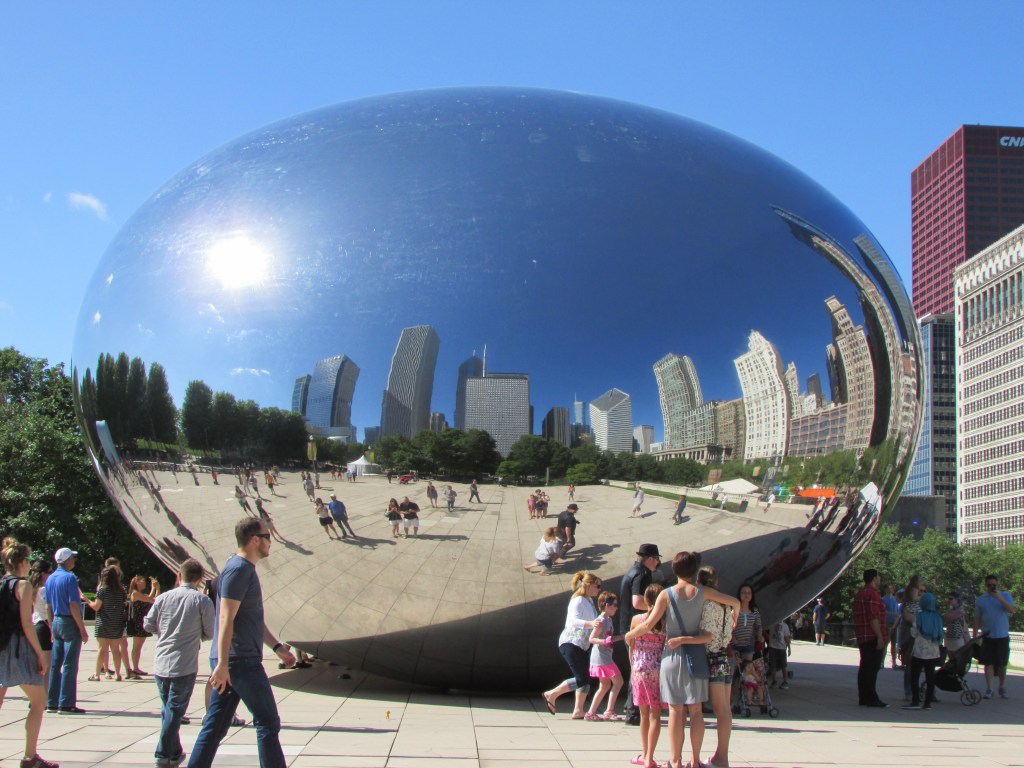
The photo is a side view of the Cloud Gate sculpture (affectively known as the Bean) in Chicago. It reflects everything around you back at you and looks like a bubble from this perspective.
 Brookline Polymath